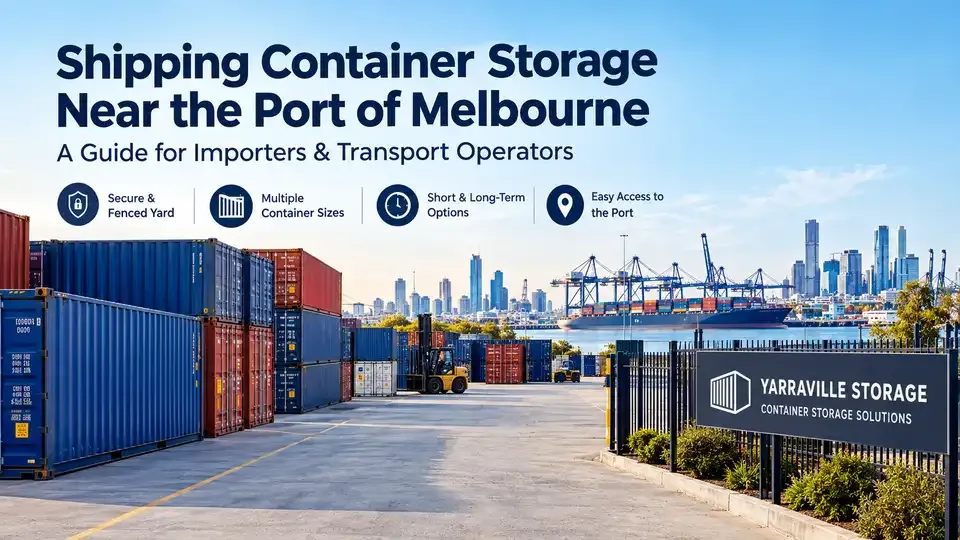
Quick answer: If you need to store a shipping container near the Port of Melbourne, use a secure container yard in the inner west. Suburbs like Yarraville are a short drive from Swanson Dock and the West Gate Freeway. A good yard offers a solid hardstand surface, suitable access for heavy vehicles, CCTV and gated security, and flexible short or long-term terms.
The rest of this guide explains who uses container storage and the different types available. It also covers how storage relates to detention and demurrage charges, what to check before you choose a yard, and what affects the price.
Why does storing containers close to the port matter?
The Port of Melbourne is Australia's busiest container port. Every container that comes off a ship has to go somewhere, and every kilometre between the terminal and that somewhere costs money.
Storing close to the port helps in three ways:
- Shorter truck runs. Fewer kilometres per move means lower transport costs and more moves per truck per shift.
- Easier terminal timing. When your box is parked a short drive from the docks, it's easier to hit booked terminal slots and pick-up windows.
- Flexibility. You can hold a container close by until your warehouse, site or customer is ready, instead of rushing a delivery or paying for a second trip.
Yarraville sits in Melbourne's inner west, close to Swanson Dock, the West Gate Freeway and the main freight routes. That makes it a practical base for anyone moving containers in and out of the port. Our yard is about 17 minutes from the Swanson Dock terminals.
Who uses container storage in Melbourne?
Container yards aren't only for big logistics companies. Our customers typically include:
- Importers who need to hold a container until their warehouse has space, staff or a delivery slot.
- Exporters packing and staging containers before they head back to the port.
- Freight forwarders and transport operators who need a reliable drop point near the docks to balance loads and truck schedules.
- Builders and construction companies storing site containers between projects.
- Businesses that own their containers and use them as secure storage for stock, equipment or seasonal items.
- Private owners who have bought a container for a move, a farm or a project and need somewhere to keep it.
What types of container storage are available?
Empty container storage
This means parking an empty container, usually one you own, until it's needed again. It's common for businesses that run their own containers, and for anyone between projects.
Loaded (full) container storage
This means holding a packed container before it's unpacked or delivered. Importers use it when the goods have arrived but the destination isn't ready yet.
Container-as-storage
Here the container itself is your storage unit. You keep stock, tools, equipment or household items inside it, the container sits in a secure yard, and you access it when you need to.
Short-term vs long-term
Short-term storage covers days to a few weeks and suits import timing gaps, site transitions and moves. Long-term storage covers months or more and suits owned containers, seasonal stock and equipment. Our minimum term is one week, billed monthly.
Detention, demurrage and storage: what's the difference?
If you import, you've likely been hit with one of these charges. The terms are often mixed up, and each carrier and terminal sets its own rules, so always check your booking. Generally:
| Charge | What it's for | Who charges it | Clock stops when… |
|---|---|---|---|
| Demurrage / port storage | A container staying at the terminal beyond the free time | Shipping line and/or terminal | The container leaves the terminal |
| Detention | Keeping a shipping line's container outside the terminal beyond the free days | Shipping line | The empty container is returned |
| Private yard storage | Parking a container in a yard like ours | The storage yard | You collect the container |
How storage fits in:
- Moving a box out of the terminal promptly stops terminal-side charges building up. A nearby yard gives you somewhere to put it when your final destination isn't ready.
- Detention keeps running on shipping-line containers until the empty is returned, even while they sit in a private yard. For carrier-owned boxes, storage is a short bridge, not a long-term fix. Unpack and return the empty within your free days where you can.
- Storage works best long-term for containers you own (sometimes called shipper-owned containers, or SOC). There's no detention clock on those, so the only cost is your storage rate.
Tip: Before your ship arrives, check your free days with your carrier or forwarder. Then plan the pick-up, storage and unpack dates so nothing tips into extra charges.
What should you look for in a container storage yard?
Not every yard is set up for containers. Before you book, check these:
- Heavy vehicle access. Can a semi-trailer, B-double or side-loader get in, turn and get out easily? Tight gates and narrow streets cost you time.
- Hardstand surface. A container needs a firm, level base. Soft ground causes sinking, door alignment problems and water pooling.
- Handling equipment. Find out whether the yard can lift or move containers on site, or whether you need to bring a side-loader.
- Security. Look for perimeter fencing, gated or controlled access, CCTV and good lighting. Ask who can enter and how access is recorded.
- Access hours. Transport doesn't run 9 to 5. Make sure the yard's hours match your truck schedules.
- Flexible terms. Short-term options with no lock-in contracts matter when shipping schedules change.
- Clear pricing. You should know exactly what you'll pay per container, per period, and for any lifts or moves.
- Insurance clarity. Understand what the yard covers and what you need to insure yourself.
Container sizes: how much space will you need?
Most storage is priced per container slot, so size matters. The standard container types are:
| Container | Approx. length | Approx. width | Approx. height | Common use |
|---|---|---|---|---|
| 10ft standard | 2.99 m | 2.44 m | 2.59 m | Tools, small business stock, tight sites |
| 20ft standard | 6.06 m | 2.44 m | 2.59 m | Heavy goods, site storage, smaller moves |
| 40ft standard | 12.19 m | 2.44 m | 2.59 m | Bulk imports, larger stock |
| 40ft high cube | 12.19 m | 2.44 m | 2.90 m | Bulky, light goods needing extra height |
External dimensions. Allow extra space in front of the doors if you need to open them and access the contents while the container is in storage.
How much does container storage cost in Melbourne?
Container storage pricing usually depends on:
- Container size. A 40ft container takes up roughly twice the space of a 20ft.
- Length of stay. Longer terms usually earn a lower rate.
- Loaded or empty. Some yards price these differently.
- Handling. Lifts, repositioning or on-site moves may cost extra.
- Access needs. You'll pay more for a container placed so you can open the doors than for one that just needs parking.
Tips for storing a shipping container
- Check the container's condition first. Look for holes, rust spots and door seal damage before you store it.
- Keep moisture out. Use desiccant bags or moisture absorbers, especially over Melbourne's damp winters, and make sure contents are dry when packed.
- Use a quality lock. A lock box or high-security padlock deters tampering.
- Keep an inventory. Photograph and list what's inside, which helps with insurance claims.
- Think about access. If you'll need to get into the container during storage, tell the yard so it's positioned with the doors accessible.
- Record seal numbers on loaded import or export containers.
Why store your container at Yarraville Storage?
Yarraville Storage is a dedicated storage yard in Melbourne's inner west, close to the Port of Melbourne and the main freight routes out of the city. We store shipping containers alongside vehicles and equipment and machinery, so our yard is built for heavy, oversized assets rather than household boxes.
| Close to the port | 17 minutes to Swanson Dock |
|---|---|
| Heavy vehicle access | Yes, we have wide gates and clear access for large vehicles. |
| Security | Perimeter fencing, gated access, CCTV coverage, and good lighting. |
| Access hours | 8 AM - 5 PM, Monday to Friday |
| Flexible terms | Month-to-month with no lock-in contract. |
| Handling | We offer container lifting and moving services on site. |
Find out more about our secure container storage in Yarraville, or get a quote today.
Frequently asked questions
Can I store a shipping container near the Port of Melbourne short-term?
Yes. Many importers and transport operators use nearby yards to hold containers for days or weeks while a warehouse, site or customer gets ready. Yarraville Storage offers short-term container storage with a minimum term of one week.
Does storing a shipping line's container stop detention charges?
No. Detention usually keeps running until the empty container goes back to the shipping line. Private storage helps you get a box out of the terminal quickly, but plan to unpack and return carrier-owned containers within your free days.
Can I access my container while it's in storage?
Yes, during our access hours of 8 AM - 5 PM, Monday to Friday. Let us know when booking so we can position your container with the doors accessible.
Do you store both 20ft and 40ft containers?
Yes. We store 20ft and 40ft standard containers and 40ft high cubes.
Is my container insured while in storage?
No, check with your own insurer. Many business and cargo policies cover stored goods, but conditions vary.